
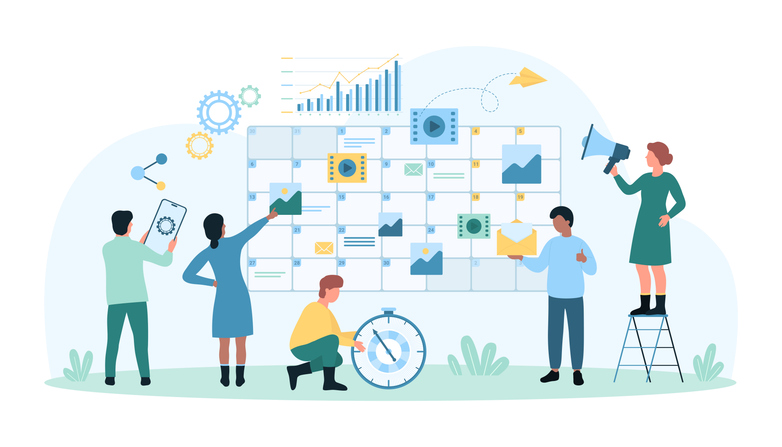
How to Build a LinkedIn Content Calendar That Actually Generates Leads
Let’s be honest. Most businesses aren’t struggling because they don’t know how to post on LinkedIn.
They’re struggling because they don’t know what to post, who they’re trying to reach, or what they’re expecting those posts to accomplish.
Someone remembers to share a company update on Monday. A salesperson posts something on Wednesday. Maybe the owner shares an industry article on Friday.
Then nothing happens for two weeks.
Sound familiar?
The problem isn’t necessarily LinkedIn. It’s the lack of a strategy behind the activity.
LinkedIn can be an incredibly valuable business development tool, particularly for B2B companies, consultants, professional service providers, commercial lenders, and organizations selling higher-value services.
But getting results requires more than posting whenever you have something to say.
You need a plan.
A well-developed LinkedIn content calendar helps you stay consistent, build credibility, engage the right audience, and create opportunities for new business.
More importantly, it gives your marketing a purpose.
At Vasilakos Design, we believe LinkedIn should be treated as part of your overall lead generation strategy, not just another social media channel that needs to be updated.
Here’s how to build a content calendar that can help turn LinkedIn activity into actual business opportunities.
Why Your Business Needs a LinkedIn Content Calendar
One of the biggest mistakes businesses make with LinkedIn is treating it as an afterthought.
They post when they have time, share an occasional company announcement, and hope the right people happen to see it.
That’s not much of a strategy.
A content calendar gives you a framework for planning what you’re going to publish, when you’re going to publish it, and why it matters.
It also helps you avoid the constant question:
“What should I post today?”
A good LinkedIn content strategy can help your business:
- Build brand awareness with your ideal customers.
- Establish credibility and industry expertise.
- Keep your company visible to potential buyers.
- Start conversations with prospects.
- Support your sales and business development efforts.
- Drive qualified visitors to your website.
- Generate inbound inquiries and opportunities.
There’s another benefit that’s easy to overlook.
Your content can help warm up potential prospects before your sales team ever contacts them.
Think about it.
Someone receives a LinkedIn connection request or outreach message from your company. Before responding, they visit your profile.
What do they see?
If they find helpful information, relevant industry insights, and evidence that you understand their business challenges, you’ve already made a better first impression.
If your last post was six months ago, that opportunity is probably being wasted.
Your LinkedIn content should give people a reason to trust you before you ever ask them for their business.
Step 1: Know Who You’re Trying to Reach
Before creating a content calendar, you need to know who you’re creating content for.
This sounds obvious, but it’s where many businesses get things wrong.
They create content around what they sell instead of what their customers actually care about.
For example, a commercial lender might want to publish posts about financing products, loan programs, and interest rates.
Those are important topics.
But what are their potential customers actually thinking about?
A commercial real estate investor might be asking:
- How can I finance my next property acquisition?
- Why did my bank decline my commercial loan?
- What are my options if I don’t meet traditional lending requirements?
- How much capital do I need to expand my portfolio?
A business owner might be thinking:
- How do I generate more consistent revenue?
- Why isn’t my marketing producing qualified leads?
- How do I compete with larger companies?
- Where should I be investing my marketing budget?
These questions provide much better content opportunities.
Start by defining your ideal customer profile (ICP).
Consider:
Industry: Which industries are you targeting?
Job Title: Who makes the purchasing decisions?
Company Size: Are you targeting small businesses, growing companies, or enterprise organizations?
Challenges: What problems are they trying to solve?
Buying Triggers: What causes them to start looking for your products or services?
The more specific you are, the easier it becomes to create content that resonates.
You don’t need everyone on LinkedIn to see your posts.
You need the right people to see them.
Step 2: Establish Three or Four Content Pillars
Once you understand your audience, decide what you want to be known for.
These are your content pillars.
Think of them as the recurring themes that guide your LinkedIn activity.
I generally recommend starting with four.
1. Educational Content
This is where you demonstrate that you understand your industry.
Share information that helps your audience solve problems, make better decisions, or understand something they might not know.
Examples:
- Five common mistakes businesses make when generating leads.
- What business owners should know before investing in SEO.
- Three financing options when traditional banks say no.
- What to look for when hiring a marketing agency.
- How to improve your website conversion rate.
You don’t need to give away your entire business model.
You simply need to demonstrate that you know what you’re talking about.
2. Industry Insights and Opinions
This is where your personality and experience come into play.
Share your thoughts about industry trends, changes in technology, common misconceptions, and things you see businesses doing wrong.
For example:
- Why more website traffic doesn’t always mean more business.
- Why AI isn’t a replacement for marketing strategy.
- Why businesses should stop chasing vanity metrics.
- How changing customer expectations are affecting sales.
- Why traditional marketing tactics sometimes stop working.
Don’t be afraid to have an opinion.
A LinkedIn feed filled with generic advice isn’t particularly memorable.
People want to hear from someone who has actually worked in the industry.
3. Results and Success Stories
People want to know whether you can deliver.
This is where client stories, case studies, testimonials, and real-world examples become valuable.
You might share:
- A website redesign that improved conversions.
- An SEO campaign that increased organic traffic.
- A lead generation campaign that produced qualified inquiries.
- A client challenge and how you approached it.
- A lesson learned from a successful campaign.
You don’t always need to publish detailed statistics or identify the client.
Sometimes explaining the problem, your approach, and the outcome is enough.
Just make sure any results you share are accurate and supported.
4. Personal and Relationship-Building Content
This is especially important on LinkedIn.
People do business with people.
Share something about your experience, your approach to business, lessons you’ve learned, or what you’re currently working on.
It doesn’t all need to be directly related to your services.
A personal observation or professional experience can generate more meaningful conversations than another promotional post.
For business owners and executives, this is also a good opportunity to establish a recognizable voice.
Your company page represents your business. Your personal profile gives people a reason to connect with the person behind it.
Step 3: Decide How Often You Should Post
Consistency matters more than trying to publish something every day.
I’ve seen businesses start with ambitious posting schedules, only to abandon them a few weeks later.
That’s not helpful.
For most small and medium-sized B2B businesses, I’d recommend starting with three posts per week.
That’s enough to establish a regular presence without overwhelming your schedule.
Here’s a simple weekly structure:
| Day | Content Type | Objective |
|---|---|---|
| Monday | Educational or industry insight | Build authority |
| Wednesday | Client story or practical advice | Build credibility |
| Friday | Opinion, question, or discussion | Encourage engagement |
You can add more posts as your audience and content production process grow.
The important thing is finding a schedule you can maintain.
I’d rather see a business publish three thoughtful posts every week for six months than publish every day for two weeks and disappear.
Give your strategy time to develop.
Step 4: Create Content That Starts Conversations
Here’s something worth remembering:
Not every LinkedIn post needs to sell something.
In fact, if every post is promotional, people will quickly lose interest.
Your content should give people a reason to engage with your business.
There are several ways to accomplish this.
Ask Questions
Questions are an easy way to encourage discussion.
Examples:
- What’s the biggest challenge your business is facing with lead generation?
- Are you still investing in traditional SEO, or are you shifting toward AI Search?
- What’s more important: generating more leads or improving your conversion rate?
- What is one marketing mistake you wish you had avoided?
Make sure the question is relevant to your target audience.
Share an Opinion
You don’t need to agree with everything happening in your industry.
Some of the best discussions come from challenging commonly accepted ideas.
For example:
“More leads aren’t always the answer. Sometimes businesses need to get better at converting the leads they already have.”
That’s a conversation starter.
Share Something Useful
Give your audience something they can actually apply.
A checklist, short tutorial, quick tip, or explanation of a common problem can encourage people to save and share your content.
Tell a Story
Talk about a client situation, something you learned, or an experience that changed how you approach your work.
Stories help people connect with the person behind the business.
The goal isn’t to manufacture engagement.
It’s to give your audience something worth responding to.
Step 5: Use Different LinkedIn Content Formats
Not every post needs to look the same.
LinkedIn offers several ways to communicate with your audience.
The best approach is to use formats that support the message you’re trying to deliver.
Text Posts
Sometimes a simple text post is all you need.
Share an opinion, an observation, a lesson, or a question.
These are particularly useful for personal profiles because they allow your voice and personality to come through.
Document and Carousel Posts
These are useful when you want to break down information into smaller, easy-to-follow sections.
Examples include:
- Five ways to improve your LinkedIn profile.
- A step-by-step lead generation framework.
- SEO mistakes businesses should avoid.
- A checklist for preparing your website for AI Search.
They also give people something they can save and reference later.
Short-Form Video
Video is a great way to introduce yourself and demonstrate expertise.
You don’t need an expensive production setup.
A simple 60-second video explaining a marketing concept or answering a common customer question can be effective.
Case Studies
Show people what you’ve accomplished.
Explain the challenge, your approach, and the results.
This is particularly valuable for businesses selling professional services because prospective customers want evidence that you can solve their problems.
Articles and Newsletters
Longer-form content gives you an opportunity to explore a subject in more detail.
Use articles to address questions your customers are researching and newsletters to build an ongoing relationship with your audience.
The key is not trying to use every format at once.
Start with two or three formats that fit your business and expand from there.
Step 6: Build a 30-Day LinkedIn Content Calendar
Now let’s put everything together.
You don’t need a complicated content management system to get started.
A spreadsheet is perfectly fine.
Your calendar should include:
- Publishing date.
- Target audience.
- Content topic.
- Content pillar.
- Post format.
- Objective.
- Call to action.
- Publishing status.
Here’s an example of a simple four-week calendar for a B2B company.
Week 1: Establish Your Expertise
| Day | Post Topic | Objective |
|---|---|---|
| Monday | Three common mistakes businesses make with lead generation | Education |
| Wednesday | A client success story or marketing lesson | Credibility |
| Friday | What’s the biggest challenge facing your business right now? | Engagement |
Week 2: Demonstrate Your Knowledge
| Day | Post Topic | Objective |
|---|---|---|
| Monday | Why more website traffic doesn’t always mean more customers | Education |
| Wednesday | A behind-the-scenes look at your process | Trust |
| Friday | What’s one business expense you think companies waste money on? | Engagement |
Week 3: Build Relationships
| Day | Post Topic | Objective |
|---|---|---|
| Monday | An industry trend that businesses should pay attention to | Authority |
| Wednesday | A practical tip your customers can use immediately | Education |
| Friday | An unpopular opinion about your industry | Discussion |
Week 4: Create Business Opportunities
| Day | Post Topic | Objective |
|---|---|---|
| Monday | A common problem your ideal customer experiences | Awareness |
| Wednesday | A case study or example of how you solved that problem | Credibility |
| Friday | Invite businesses to discuss their current challenges | Conversion |
Notice that only one or two posts each week need to directly promote your services.
The rest should focus on demonstrating knowledge, building relationships, and staying visible.
This is how you create a presence that feels helpful rather than constantly sales-driven.
Step 7: Don’t Just Post. Participate.
This is probably one of the most overlooked parts of LinkedIn marketing.
Publishing content is important, but engagement shouldn’t stop when you hit the post button.
You need to participate in conversations happening across your industry.
That means:
- Commenting on posts from potential customers.
- Responding to comments on your own posts.
- Sharing useful industry information.
- Engaging with professional organizations.
- Connecting with people who fit your ideal customer profile.
- Following up with people who show genuine interest.
Don’t just leave comments like “Great post!” or “Thanks for sharing.”
Add something meaningful.
Share an experience, ask a question, or offer another perspective.
The goal is to become part of the conversation.
This also creates opportunities to connect with potential customers without immediately asking them for business.
Step 8: Combine Content Marketing With LinkedIn Outreach
Here’s where LinkedIn becomes particularly interesting for B2B businesses.
You don’t have to choose between organic content and direct outreach.
They can work together.
Think about the typical LinkedIn prospecting process.
You identify a company that fits your ideal customer profile.
You find the right decision-maker.
You send a personalized connection request.
But what happens when that person visits your profile?
If they see relevant content, useful insights, and evidence of your experience, you’ve given them another reason to trust you.
Your content helps establish credibility.
Your outreach creates the opportunity to start a conversation.
Your follow-up helps nurture the relationship.
That’s a much stronger approach than sending hundreds of generic connection requests and hoping someone responds.
At Vasilakos Design, we approach LinkedIn lead generation as a combination of targeting, personalized messaging, consistent engagement, and ongoing optimization.
The objective isn’t simply to increase your connection count.
It’s to create conversations with people who could become customers.
Step 9: Measure the Results That Actually Matter
One of the biggest mistakes businesses make with social media is focusing too much on likes and impressions.
Those numbers can be useful, but they don’t tell you whether your LinkedIn strategy is producing business.
You need to look beyond surface-level engagement.
Here are the metrics I’d pay attention to.
| Metric | What It Tells You |
|---|---|
| Profile views | Whether people are interested in learning more about you |
| Follower growth | Whether your audience is expanding |
| Post impressions | How far your content is reaching |
| Comments and shares | Whether your content is generating interest |
| Website clicks | Whether LinkedIn is driving visitors to your site |
| Qualified inquiries | Whether you’re attracting potential customers |
| Meetings booked | Whether engagement is creating sales opportunities |
| Revenue generated | Whether your marketing is contributing to business growth |
I’d also recommend using UTM tracking on links to your website so you can identify traffic and conversions originating from LinkedIn.
Review your results every month.
Which topics generated meaningful conversations?
Which posts attracted the right people?
Which content drove profile visits or website traffic?
Which interactions eventually turned into opportunities?
Use those answers to improve the next month’s calendar.
Don’t keep publishing something just because it received a lot of likes.
Publish more of what attracts the people you actually want to work with.
A Few Common LinkedIn Content Mistakes to Avoid
Before you start building your calendar, here are some things I’d avoid.
1. Making every post an advertisement.
People don’t log into LinkedIn just to see advertisements. Give them something useful.
2. Trying to appeal to everyone.
If your content is too broad, it becomes difficult to attract the right audience.
3. Copying competitors.
Pay attention to what’s working, but don’t build your entire strategy around repeating someone else’s content.
4. Posting without a clear purpose.
Every post should have a reason to exist, even if that reason is simply starting a conversation.
5. Ignoring comments and messages.
Engagement is a two-way street. Respond to people and build relationships.
6. Giving up too early.
LinkedIn content marketing is a long-term effort. Give your strategy enough time to establish consistency, build an audience, and generate meaningful data.
7. Measuring the wrong things.
A thousand likes mean very little if none of the people engaging with your content could ever become customers.
Frequently Asked Questions About LinkedIn Content Calendars
How often should a business post on LinkedIn?
For most B2B businesses, starting with three quality posts per week is a practical approach. Consistency and relevance are more important than publishing every day.
What should a business post on LinkedIn?
Focus on educational content, industry insights, customer success stories, practical advice, and questions that encourage discussion. Your content should address the challenges and interests of your ideal customers.
Are personal LinkedIn profiles better than company pages?
Personal profiles are particularly effective for building relationships and sharing individual expertise. Company pages are important for brand credibility, company updates, and business information. The strongest strategy uses both.
How long does it take to generate leads from LinkedIn?
There isn’t a guaranteed timeline. Some businesses generate conversations quickly through targeted outreach, while organic content marketing generally takes longer to build momentum. Consistent publishing, engagement, and measurement help you understand what’s working.
Can LinkedIn content generate B2B leads?
Absolutely. Helpful content can build awareness, establish credibility, attract profile visits, and encourage prospects to contact your business. It works particularly well when combined with targeted networking and personalized outreach.
Do I need a LinkedIn content calendar?
If LinkedIn is an important part of your business development strategy, a content calendar can help you stay organized, maintain consistency, and make sure your posts support your marketing goals.
Turn Your LinkedIn Activity Into a Lead Generation Strategy
LinkedIn has tremendous potential for businesses looking to connect with decision-makers, build relationships, and generate new opportunities.
But simply having a company page or occasionally sharing an update isn’t enough.
You need to know who you’re targeting, what they care about, and how your content can help establish a relationship with them.
More importantly, you need a strategy that connects content, networking, outreach, and follow-up.
That’s where many businesses need help.
At Vasilakos Design, we help companies build more effective digital marketing and lead generation strategies, including LinkedIn outreach, content development, SEO, and website optimization.
Whether you need help creating a LinkedIn content calendar, building a consistent outreach campaign, or developing a more complete marketing strategy, we can help you put the pieces together.
Stop posting just to stay active. Start using LinkedIn to create business opportunities.
Let’s talk about your LinkedIn lead generation strategy.
Vasilakos Design | Fractional CMO. Digital Marketing. Marketing Consulting.